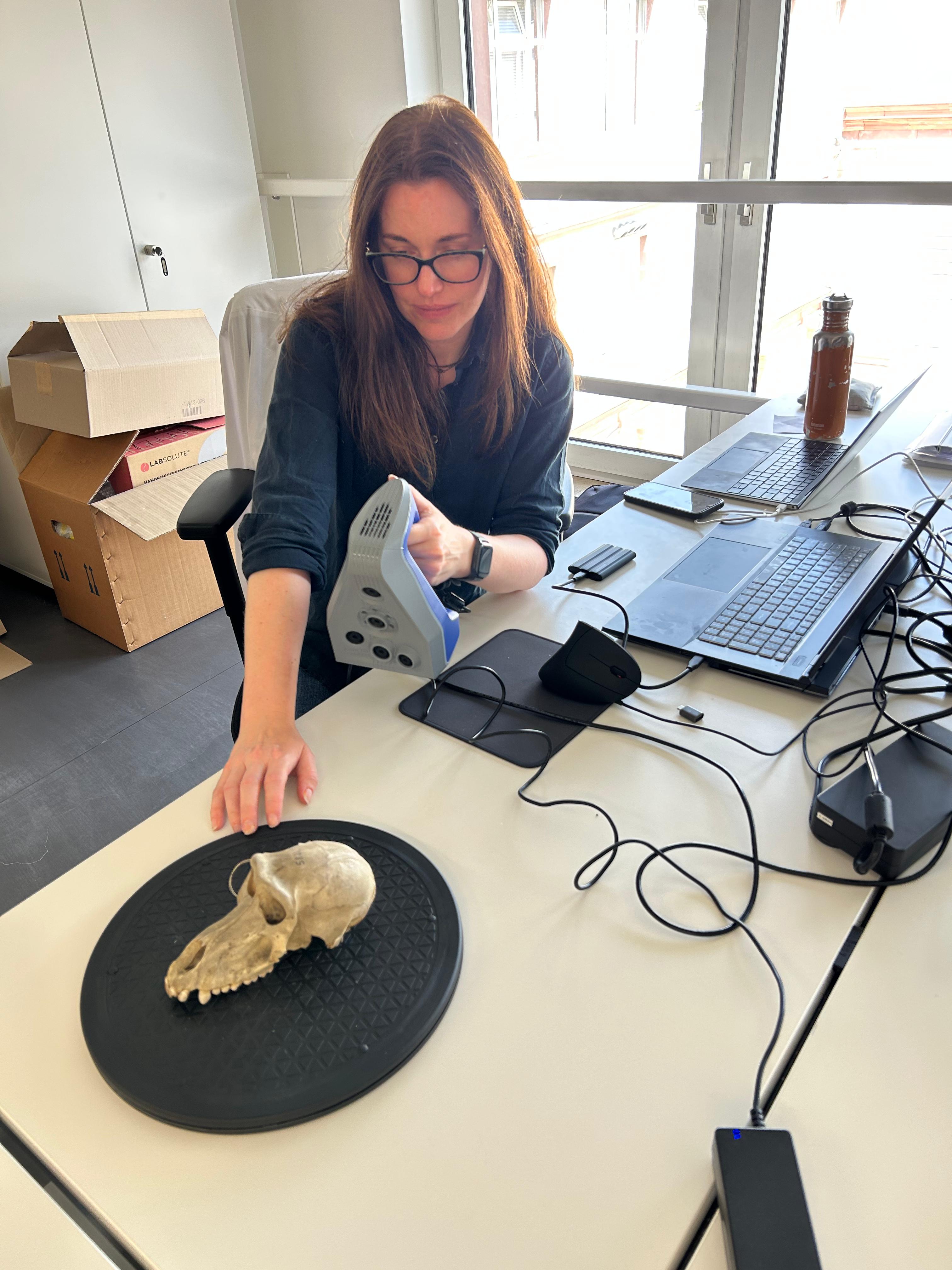
Photo courtesy of Dr. Marianne Brasil
I am a biological anthropologist and evolutionary morphologist researching human and non-human primate skeletal evolution. Currently, I am a postdoctoral researcher in the Primate Evolution Lab at Western Washington University, working under the direction of Dr. Tesla Monson and Dr. Marianne Brasil. I completed my dissertation on cranial and pelvic evolution in anthropoid primates (apes and monkeys) and my master’s project on limb evolution in catarrhine primates (African and Asian apes and monkeys) at the Buffalo Human Evolutionary Morphology Lab under Dr. Noreen von Cramon-Taubadel.
Generally speaking, I am interested in how the shape and form of the skeleton have changed over evolutionary time, with an emphasis on using comparative skeletal anatomy over a broad phylogeny to better understand human (and non-human primate) evolution. Specifically, I am interested in how morphological covariation, or the interaction between skeletal features that constrains how different parts of the skeleton may change relative to one another, affects skeletal evolution and variation. I am particularly interested in how covariation may facilitate or constrain response to selection driven by behavior and/or function, and seek to understand issues of broader social significance – such as obstructed labor – through a deeper understanding of evolutionary history. I primarily use 3D surface scans (structured light scans) in my research, and have had the pleasure of working in domestic (U.S.) and international mammalian skeletal collections. Additional information about my research can be found here and at my ResearchGate profile. My CV can be found here.
Beyond research, I have experience working in science education in museums, both with the public and behind the scenes; selecting, training, and supervising volunteers of all ages in science education and non-profit administration; and university-level teaching in both lecture and dissection-based lab courses. Further information on my university-level teaching can be found here.
 MARIANNE J. COOPER, Ph.D.